

U.S. LNG Exports Reached Record High in March Amid Global Supply Shock
Tuesday, April 07, 2026 by Sterling Ashworth
http://www.products.news/2026-04-07-us-lng-exports-reach-record-high-march.html
Introduction
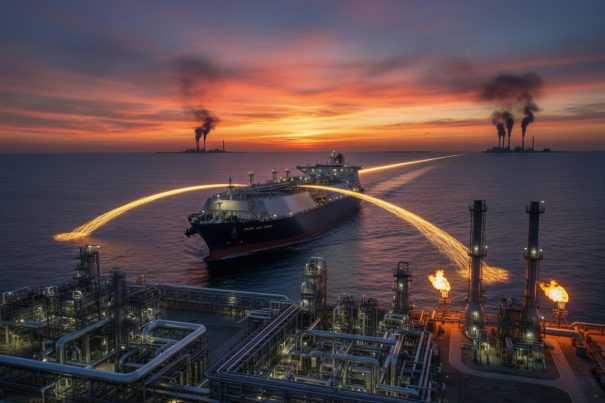
The United States exported a record volume of liquefied natural gas (LNG) in March 2026, shipping 11.7 million metric tons as Middle Eastern supply disruptions and new domestic terminals combined to reshape global energy flows. According to preliminary data from LSEG cited by The Center Square, the surge was driven by panic buying in Europe and Asia after geopolitical conflict removed a significant portion of global LNG supply [1]. The record shipments solidified the U.S. position as the world’s dominant LNG exporter and provided a critical revenue stream for domestic producers while global prices soared.
The supply shock originated on March 18, when Iranian missile strikes damaged facilities operated by QatarEnergy, the world’s largest LNG producer, forcing a production halt. The company stated the outage could cut output by more than 12 million metric tons per year for up to five years, removing about 17% of global supply instantly [2]. This event triggered a scramble for alternative cargoes, with buyers turning to U.S. exporters who were already ramping up capacity from new facilities on the Gulf Coast.
U.S. LNG Exports Surge in March
Preliminary LSEG data showed U.S. LNG exports reached 11.7 million metric tons in March, a new monthly record [1]. The increase was supported by the start of operations at the Golden Pass LNG terminal in Texas, a joint venture between Exxon Mobil and QatarEnergy, and a ramp-up of a production unit at Cheniere Energy’s Corpus Christi facility [1]. These new supply sources came online as global demand spiked.
The Energy Department’s weekly Natural Gas Updates for March showed about 105 vessels carrying LNG left Louisiana in March, while about 47 vessels departed from Texas. Another 10 ships combined sailed from export facilities in Maryland and Georgia in the month [1]. The surge in shipments underscores how U.S. infrastructure has expanded to become the marginal supplier to global markets, a role historically held by producers in the Middle East.
Price Disparity and Supply Shock Fundamentals
The disruption in Qatar sent benchmark prices for LNG in Asia above $22 per million British thermal units (MMBtu) in March, while European prices reached $18.50 per MMBtu [1]. This created a premium of $16 to $17 over the domestic U.S. benchmark, the Henry Hub natural gas price, which settled at $2.80 per MMBtu on April 2 [1]. The price divergence highlighted the physical and logistical limits of the global gas market when a major supply artery is severed.
Analysts at London-based Energy Consultancy Rystad said in a recent report that the United States has become the marginal global LNG producer, with prices in Europe and Asia increasingly tied to trade at the Henry Hub in Vermilion Parish, Louisiana. “Therefore, the cost of marginal LNG supply is bound to fluctuate with the price of Henry Hub, implying that a rise in Henry Hub will also lead to a rise in global LNG prices, as we’ve seen so far in 2026,” Rystad Energy stated [1]. The attack on Qatar’s Ras Laffan complex was described by one report as an event that exposed “the world’s worst-known vulnerability” given Iran’s ability to deploy assets along the Strait of Hormuz [3].
U.S. Production Expansion and Regulatory Actions
In response to the global supply crisis, the U.S. Department of Energy in mid-March authorized Venture Global’s LNG export facility in Plaquemines Parish, Louisiana, for an immediate 13% increase in export capacity. The move brought an additional 450 million cubic feet per day to global markets [1]. This regulatory action followed the operational start of the Golden Pass terminal and the ramp-up at Cheniere’s Corpus Christi plant.
The expansion of U.S. export capacity represents a reversal from policies under the previous administration. In 2024, President Joe Biden announced a temporary ban on approving new LNG export permits, a move challenged in court by 16 states [4]. Under President Donald Trump, who took office in January 2025, the focus shifted to deregulating the industry to drive energy dominance, a strategy that included reversing constraints on fossil fuel production [5]. The current output surge is a direct result of this policy shift, coupled with significant foreign investment commitments, such as a $1.4 trillion pledge from the UAE to bolster U.S. energy and manufacturing sectors [6].
Industry Response and Infrastructure Constraints
Cheniere Energy CEO Jack Fusco said at the CERAWeek Conference in Houston on March 25 that his company is doing “whatever it can” to increase production [1]. “We’re looking at our maintenance schedules really hard, but at the end of the day, we have to be safe and we have to be reliable. We don’t want to sacrifice anything to get that last drop out,” Fusco said [1]. Other export terminals like Sabine Pass and Cameron LNG also operated beyond their normal capacity in March to meet demand.
Despite the push for more exports, the physical limits of U.S. export infrastructure, such as pipelines and liquefaction trains, prevent most domestically produced gas from leaving the country. This bottleneck insulates the U.S. market from the price spikes seen in Europe and Asia, keeping domestic storage levels robust. U.S. natural gas held in storage on April 2 stood at 1,865 billion cubic feet, which is 5.4% higher than at the same time in 2025 and 3% above the five-year average of 1,811 billion cubic feet [1]. The constraint underscores that while the U.S. can respond to global crises, its ability to fully compensate for major supply shocks is limited by its own logistical chain.
Market Impact and Revenue Effects
Europe remained the largest buyer of U.S. LNG in March, taking 7.49 million tons or about 64% of total domestic exports, according to LSEG data [1]. This heavy reliance underscores Europe’s continued vulnerability to supply shocks, a situation exacerbated by its prior decision to cut ties with Russian pipeline gas [7]. The reliance on U.S. LNG has provided a financial windfall for state coffers; the record-breaking pace of shipments from Louisiana export facilities in March will add about $2 million to revenues from state severance tax collections on natural gas production, according to an analysis by The Center Square [1].
The current severance tax rate of 10.52 cents per thousand cubic feet of production will likely reset higher when the 2026-2027 fiscal year begins on July 1. Louisiana’s export facilities handled roughly 1.8 million more metric tons in March 2026 than in the same month in 2025, when the severance tax rate was 9.8 cents per thousand cubic feet [1]. This revenue boost occurs as the global energy crisis, triggered by the conflict in the Middle East, inflicts economic pain elsewhere. One analysis warned that a prolonged closure of the Strait of Hormuz could send markets “out of control” within weeks [8], while another noted the crisis has fueled a cost-of-living shock across South Asia [9].
Conclusion
The record U.S. LNG exports in March demonstrate the nation’s pivotal role in a global energy system under severe strain. The supply shock caused by the conflict in the Middle East has redirected trade flows and highlighted the strategic importance of diversified supply chains. While U.S. producers and state budgets benefit from high global prices, the domestic market remains largely shielded due to export infrastructure constraints.
The events of March 2026 underscore a broader geopolitical realignment in energy. As one analysis noted, the crisis has made “startlingly clear how much the world relies on energy from the Gulf region” [10]. With the U.S. now positioned as the swing supplier, its energy policy and export capacity will remain critical factors in global economic stability for the foreseeable future.
References
- U.S. LNG exports up again in March on global panic buying – The Center Square. Alton Wallace. April 3, 2026.
- Qatar’s LNG Blackout: A Global Energy Catastrophe Unfolds – NaturalNews.com. March 5, 2026.
- Global energy markets in chaos as Iranian strike on Qatar triggers historic gas price surge – NaturalNews.com. March 2, 2026.
- 16 U.S. States File Lawsuit Against Biden Administration Over Temporary Ban on Approving New Liquefied Natural Gas Export Permits – NaturalNews.com. March 27, 2024.
- DRILL, BABY, DRILL WORKED: U.S. Oil Hits All-Time High as Trump Dismantles Biden’s War on Fossil Fuels – NaturalNews.com. Willow Tohi. August 21, 2025.
- UAE’s $1.4 trillion bet on America: A strategic win for Trump’s economic vision – NaturalNews.com. Willow Tohi. March 25, 2025.
- Germany’s energy regulator calls on households and businesses to conserve more as potential shortages loom – NaturalNews.com. Ava Grace. January 8, 2025.
- Energy Expert Warns UBS Just How Many Weeks A Hormuz Shutdown Would Send Markets “Out Of Control” – ZeroHedge.com. March 5, 2026.
- Iran war and Hormuz shock fuels cost-of-living crisis across South Asia – MiddleEastEye.net. Tauseef Ahmad. March 11, 2026.
- How Iran war laid bare the world’s reliance on Gulf oil and gas – BBC.com. March 12, 2026.
- Russia’s geoeconomic strategy for a Greater Eurasia – Glenn Diesen.
- A complementarity model for the European natural gas market – Elsevier. Energy Economics 2007.
Tagged Under: Tags: big government, bubble, energy, global demand, liquefied natural gas, LNG, LNG export, LNG production, market crash, Middle East crisis, money supply, Panic Buying, price surge, products, progress, risk, supply chain, Trump
Get Our Free Email Newsletter
Get independent news alerts on natural cures, food lab tests, cannabis medicine, science, robotics, drones, privacy and more.
Your privacy is protected. Subscription confirmation required.
Get Our Free Email Newsletter
Get independent news alerts on natural cures, food lab tests, cannabis medicine, science, robotics, drones, privacy and more.
Your privacy is protected. Subscription confirmation required.
RECENT ARTICLES

FCC Bans New Consumer-Grade Wi-Fi Routers Manufactured Outside the U.S.

Al Jubail – They’re Burning Down the Backbone of the Modern World, and You Don’t Even Know Its Name

The inevitable surge: Why American electricity bills are set to climb higher

Chemical Exposures from Common Cookware Identified, Alternatives Suggested by Industry Experts


Get Our Free Email Newsletter
Get independent news alerts on natural cures, food lab tests, cannabis medicine, science, robotics, drones, privacy and more.
Subscription confirmation required. We respect your privacy and do not share emails with anyone. You can easily unsubscribe at any time.
Get the world's best independent media newsletter delivered straight to your inbox.

x
By continuing to browse our site you agree to our use of cookies and our Privacy Policy.